by B. N. Sullivan
Tomorrow is the second anniversary of the historic, successful ditching of US Airways Flight 1549 in the Hudson River. Now retired, Captain Chesley "Sully" Sullenberger, who was in command of that Airbus A320 on January 15, 2009, reflects on what he calls the "experience of a lifetime."
If the video does not play or display properly above, click here to view it on YouTube
Thanks to the Associated Press for posting the video on YouTube.
Click here to view all the posts about US Airways Flight 1549 on Aircrew Buzz.

Showing posts with label occurrences. Show all posts
Showing posts with label occurrences. Show all posts
Friday, January 14, 2011
Sunday, January 09, 2011
Crew among fatalities in Iran Air Boeing 727 crash in Iran
by B. N. Sullivan
 An Iran Air Boeing 727-200 aircraft (registration EP-IRP) has crashed in northwestern Iran, in Azerbaijan province, killing more than 70 of those on board, including all crew members. Iran Air Flight IR 277 from Tehran-Mehrabad (THR) reportedly crashed into mountainous terrain following a missed approach at Urmia (Orumiyeh) Airport (OMH). The accident happened on January 9, 2011 at about 19:45 local time.
The exact number of people on board Flight IR 277 is unclear. An accident post on the Aviation Safety Network website says, "ISNA quotes the Roads and Transportation Secretary stating there were 94 passengers and eleven crew members on board. Fars News Agency reports 93 passengers and twelve crew members."
A BBC News article about the accident, quoting Iran's Fars news agency, says there were 33 survivors.
The same BBC article quoted a Red Crescent official who said that "the plane had broken into several pieces, but there was no explosion or fire."
The weather at Urmia Airport was said to be poor at the time of the accident.
UPDATE: The Aviation Herald reports:
OITR 091800Z 29004KT 0500 +SN SCT015 SCT020 OVC060 00/00 Q1016
OITR 091750Z 29004KT 0500 +SN SCT015 SCT020 OVC060 00/00 Q1016
OITR 091700Z 33004KT 0600 +SN SCT015 SCT020 OVC060 00/00 Q1016
OITR 091650Z 33004KT 0600 +SN SCT015 SCT020 OVC060 00/00 Q1016
OITR 091600Z 26004KT 0800 SN SCT015 SCT020 OVC060 00/00 Q1016
OITR 091550Z 26004KT 0800 SN SCT015 SCT020 OVC060 00/00 Q1016
OITR 091500Z 24006KT 0800 +SN SCT015 SCT020 OVC060 00/00 Q1015
The Associated Press posted this video clip about the Iran Air accident on YouTube.
If the video does not play or display properly above, click here to view it on YouTube.
The exact number of people on board Flight IR 277 is unclear. An accident post on the Aviation Safety Network website says, "ISNA quotes the Roads and Transportation Secretary stating there were 94 passengers and eleven crew members on board. Fars News Agency reports 93 passengers and twelve crew members."
A BBC News article about the accident, quoting Iran's Fars news agency, says there were 33 survivors.
The same BBC article quoted a Red Crescent official who said that "the plane had broken into several pieces, but there was no explosion or fire."
The weather at Urmia Airport was said to be poor at the time of the accident.
UPDATE: The Aviation Herald reports:
Iran's Transport Ministry said, that there was no emergency. According to tower tapes the pilot aborted the approach when he could not establish visual contact with the runway at decision height and went around indicating they wanted to return to Tehran. 33 people have been taken to hospitals, 73 have perished.METARS (via the Aviation Herald):
OITR 091800Z 29004KT 0500 +SN SCT015 SCT020 OVC060 00/00 Q1016
OITR 091750Z 29004KT 0500 +SN SCT015 SCT020 OVC060 00/00 Q1016
OITR 091700Z 33004KT 0600 +SN SCT015 SCT020 OVC060 00/00 Q1016
OITR 091650Z 33004KT 0600 +SN SCT015 SCT020 OVC060 00/00 Q1016
OITR 091600Z 26004KT 0800 SN SCT015 SCT020 OVC060 00/00 Q1016
OITR 091550Z 26004KT 0800 SN SCT015 SCT020 OVC060 00/00 Q1016
OITR 091500Z 24006KT 0800 +SN SCT015 SCT020 OVC060 00/00 Q1015
The Associated Press posted this video clip about the Iran Air accident on YouTube.
If the video does not play or display properly above, click here to view it on YouTube.

Wednesday, December 29, 2010
American Airlines Boeing 757-200 runway overrun at Jackson Hole, Wyoming
by B. N. Sullivan
 Earlier today, an American Airlines Boeing 757-200 (registration N668AA) overran runway 19 at Jackson Hole Airport (JAC), Jackson, Wyoming. The aircraft, operating as American Airlines Flight 2253, had just landed at Jackson following a flight from Chicago O'Hare International Airport. According to the U.S. National Transportation Safety Board (NTSB), there were no injuries among the 181 passengers and crew on board. No damage to the aircraft has been reported.
The NTSB, which has begun an investigation of the incident, said in a statement that the aircraft "came to a rest in hard packed snow about 350 feet beyond the runway overrun area."
There was no emergency evacuation. Passengers deplaned using stairs.
The incident occurred at about 11:38 AM local time (18:38Z), December 29, 2010. It was snowing at the time of the incident.
METARS:
KJAC 291843Z 24010KT 1SM -SN BKN004 OVC019 M03/M06 A2913
KJAC 291751Z 22007KT 3/4SM -SN BKN004 OVC010 M04/M06 A2915
UPDATE: KIDK.com has published a number of photos related to this incident. (Hat tip to @Heather_Poole for posting the link on Twitter.)

The NTSB, which has begun an investigation of the incident, said in a statement that the aircraft "came to a rest in hard packed snow about 350 feet beyond the runway overrun area."
There was no emergency evacuation. Passengers deplaned using stairs.
The incident occurred at about 11:38 AM local time (18:38Z), December 29, 2010. It was snowing at the time of the incident.
METARS:
KJAC 291843Z 24010KT 1SM -SN BKN004 OVC019 M03/M06 A2913
KJAC 291751Z 22007KT 3/4SM -SN BKN004 OVC010 M04/M06 A2915
UPDATE: KIDK.com has published a number of photos related to this incident. (Hat tip to @Heather_Poole for posting the link on Twitter.)
Sunday, December 19, 2010
Two pilots perish in business jet crash in Switzerland
by B. N. Sullivan
 Earlier today, a business jet operated by Windrose Air, a German charter company, crashed and burned at Bever, Switzerland. Both pilots perished in the accident. The crew were believed to be the only people on board.
The accident happened on December 19, 2010 at approximately 15:00 local time. The aircraft, a Hawker Beechcraft [Raytheon] 390 Premier IA (registration D-IAYL) was on approach to St. Moritz-Samedan Airport (LSZS), arriving from Zagreb-Pleso (LDZA) in Croatia. It crashed into an electrical power station near the town of Bever, Switzerland. The aircraft caught fire and broke up. Some news reports suggest that the crew may have been attempting a go-around, but this has not been officially confirmed. Several news stories also mentioned that the aircraft may have hit power lines.
An article about the accident (in German) on the Swiss news website Blick.ch includes still photos and a video clip of the accident site. Another article (also in German) on the Swiss website 20min.ch has more photos and a map indicating where the plane crashed.
Condolences to the families, colleagues and friends of the pilots who lost their lives today.

The accident happened on December 19, 2010 at approximately 15:00 local time. The aircraft, a Hawker Beechcraft [Raytheon] 390 Premier IA (registration D-IAYL) was on approach to St. Moritz-Samedan Airport (LSZS), arriving from Zagreb-Pleso (LDZA) in Croatia. It crashed into an electrical power station near the town of Bever, Switzerland. The aircraft caught fire and broke up. Some news reports suggest that the crew may have been attempting a go-around, but this has not been officially confirmed. Several news stories also mentioned that the aircraft may have hit power lines.
An article about the accident (in German) on the Swiss news website Blick.ch includes still photos and a video clip of the accident site. Another article (also in German) on the Swiss website 20min.ch has more photos and a map indicating where the plane crashed.
Condolences to the families, colleagues and friends of the pilots who lost their lives today.
Wednesday, December 15, 2010
Tara Air DHC-6 Twin Otter crash in Nepal
by B. N. Sullivan
 A Tara Air DHC-6 Twin Otter crashed in Nepal on December 15, 2010. At the time of the accident, the aircraft (registration 9N-AFX) was en route from Lamidanda, Nepal to Kathmandu. A crew of three and 19 passengers were on board.
According to press reports, radio contact with air traffic control was lost shortly after the aircraft took off from Lamidanda. A rescue helicopter crew reportedly discovered what is believed to be the wreckage of the Twin Otter on a forested hillside in eastern Nepal. The AFP news service quoted a local official who said, "The aircraft smashed into pieces on impact and there are unlikely to be any survivors."
Tara Air is a subsidiary of Yeti Air.
According to press reports, radio contact with air traffic control was lost shortly after the aircraft took off from Lamidanda. A rescue helicopter crew reportedly discovered what is believed to be the wreckage of the Twin Otter on a forested hillside in eastern Nepal. The AFP news service quoted a local official who said, "The aircraft smashed into pieces on impact and there are unlikely to be any survivors."
Tara Air is a subsidiary of Yeti Air.
Monday, December 06, 2010
Qantas Flight 32: Crew response to the emergency
by B. N. Sullivan
This is the third in a series of posts about Qantas Flight 32, an Airbus A380 (registration VH-OQA) that experienced an uncontained failure of one of its four Rolls-Royce Trent 900 engines during flight on November 4, 2010. The information here is based on a preliminary report by the Australian Transport Safety Bureau (ATSB), issued On December 3, 2010.
As mentioned in the previous post, there were five flight crew on board Qantas Flight 32: the Captain (PIC); a First Officer (FO), acting as co-pilot; a Second Officer (SO); a second Captain, who was training as a Check Captain (CC); and a Supervising Check Captain (SCC), who was training the CC. This post details how they responded to the emergency following the uncontained engine failure that damaged the aircraft and a number of its systems.
Early in the emergency, given that the aircraft was controllable, the crew decided to hold their present altitude while they processed the plethora of ECAM messages that immediately followed the engine failure. [See previous post.] They contacted Singapore ATC and asked for an appropriate holding position, ultimately requesting "to remain within 30 NM (56 km) of Changi Airport in case they should need to land quickly." ATC vectored the aircraft into a holding pattern east of the airport at 7,400 ft.
 As the crew went through procedures associated with the ECAM messages, the SO went into the cabin to try to visually assess the damage to No 2 engine.
Later, the SCC and SO returned to the cabin "on numerous occasions to visually assess the damage on the left side of the aircraft, and to inspect the right side of the aircraft, and to provide feedback to the cabin crew and passengers."
Meanwhile, up on the flight deck:
Approach and Landing
Prior to leaving the holding pattern, the crew carried out a number of manual handling checks at holding speed to assess the controllability of the aircraft.
The aircraft touched down, the PIC applied maximum braking and selected reverse thrust on the No 3 engine. The aircraft came to a stop with about 150 meters of runway remaining.
After Landing
The crew shut down the remaining engines, however the No 1 engine continued to run. The crew recycled the engine master switch to OFF, but the engine still did not shut down. The crew then tried using the emergency shutoff and fire extinguisher bottles to shut down No 1 engine, but to no avail. Activating a series of circuit breakers in the aircraft's equipment bay, and efforts to starve the No 1 engine of fuel also were unsuccessful. Ultimately, "the decision was taken to drown the engine with fire-fighting foam from the emergency services fire vehicles," but this did not happen until about 2 hours and 7 minutes after the aircraft landed!
Meanwhile, passengers disembarked on the right side of the aircraft via stairs.
[Photo Source]
Click here to view all posts about Qantas Flight 32 on Aircrew Buzz.
This is the third in a series of posts about Qantas Flight 32, an Airbus A380 (registration VH-OQA) that experienced an uncontained failure of one of its four Rolls-Royce Trent 900 engines during flight on November 4, 2010. The information here is based on a preliminary report by the Australian Transport Safety Bureau (ATSB), issued On December 3, 2010.
As mentioned in the previous post, there were five flight crew on board Qantas Flight 32: the Captain (PIC); a First Officer (FO), acting as co-pilot; a Second Officer (SO); a second Captain, who was training as a Check Captain (CC); and a Supervising Check Captain (SCC), who was training the CC. This post details how they responded to the emergency following the uncontained engine failure that damaged the aircraft and a number of its systems.
Early in the emergency, given that the aircraft was controllable, the crew decided to hold their present altitude while they processed the plethora of ECAM messages that immediately followed the engine failure. [See previous post.] They contacted Singapore ATC and asked for an appropriate holding position, ultimately requesting "to remain within 30 NM (56 km) of Changi Airport in case they should need to land quickly." ATC vectored the aircraft into a holding pattern east of the airport at 7,400 ft.

As the SO moved through the cabin a passenger, who was also a pilot for the operator, brought the SO’s attention to a view of the aircraft from the vertical fin mounted camera that was displayed on the aircraft’s in-flight entertainment system. That display appeared to show some form of fluid leak from the left wing.The SO then went to the left side of the aircraft's lower deck and observed the wing damage and fuel leak. He saw a fuel trail about 0.5 m wide that appeared to be coming from underneath the wing.
Later, the SCC and SO returned to the cabin "on numerous occasions to visually assess the damage on the left side of the aircraft, and to inspect the right side of the aircraft, and to provide feedback to the cabin crew and passengers."
Meanwhile, up on the flight deck:
The flight crew reported that, during their assessment of subsequent multiple fuel system ECAM messages, they elected not to initiate further fuel transfer in response to a number of those messages, as they were unsure of the integrity of the fuel system. In addition, the crew could not jettison fuel due to the ECAM fuel jettison fault and they were aware that there was fuel leaking from the left wing. The crew also recalled an indication that the aircraft’s satellite communications system had failed. They also received an aircraft communications and automatic reporting system (ACARS)message from the aircraft operator that indicated that multiple failure messages had been received by the operator from the aircraft.It took about 50 minutes for the crew to complete procedures associated with the many ECAM messages.
They then assessed the aircraft systems to determine those that had been damaged, or that were operating in a degraded mode. They considered that the status of each system had the potential to affect the calculation of the required parameters for the approach and landing. The crew also believed that the failure may have damaged the No 1 engine, and they discussed a number of concerns in relation to the lateral and longitudinal fuel imbalances that had been indicated by the ECAM.The FO and the SCC performed several calculations to determine the landing distance required for their overweight landing. They determined that landing on Changi's runway 20C "was feasible, with 100 m of runway remaining," and advised ATC to that effect.
Approach and Landing
Prior to leaving the holding pattern, the crew carried out a number of manual handling checks at holding speed to assess the controllability of the aircraft.
As the crew started to reconfigure the aircraft for the approach by lowering flaps, they conducted further controllability checks at the approach speed and decided that the aircraft remained controllable. As a result of the landing gear-related ECAM messages, the landing gear was lowered using the emergency extension procedure and a further controllability check was conducted.Cabin crew were briefed to prepare the cabin for a possible runway overrun and emergency evacuation.
The landing performance application indicated a required approach speed of 166 kts. The flight crew reported being aware that: reverse thrust was only available from the No 3 engine, no leading edge slats were available, there was limited aileron and spoiler control, anti-skid braking was restricted to the body landing gear only, there was limited nosewheel steering and that the nose was likely to pitch up on touchdown. An ECAM message indicated that they could not apply maximum braking until the nosewheel was on the runway. The wing flaps were extended to the No 3 position.
Singapore ATC vectored the aircraft to a position 20 NM (37 km) from the threshold of runway 20C and provided for a progressive descent to 4,000 ft. The PIC was aware that accurate speed control on final would be important to avoid either an aerodynamic stall condition, or a runway overrun. Consequently, the PIC set the thrust levers for Nos 1 and 4 engines to provide symmetric thrust, and controlled the aircraft’s speed with the thrust from No 3 engine.
The autopilot disconnected a couple of times during the early part of the approach as the speed reduced to 1 kt below the approach speed. The PIC initially acted to reconnect the autopilot but, when it disconnected again at about 1,000 ft, he elected to leave it disconnected and to fly the aircraft manually for the remainder of the approach. Due to the limited landing margin available, the CC reminded the PIC that the landing would have to be conducted with no flare and that there would be a slightly higher nose attitude on touchdown.
The aircraft touched down, the PIC applied maximum braking and selected reverse thrust on the No 3 engine. The aircraft came to a stop with about 150 meters of runway remaining.
After Landing
The crew shut down the remaining engines, however the No 1 engine continued to run. The crew recycled the engine master switch to OFF, but the engine still did not shut down. The crew then tried using the emergency shutoff and fire extinguisher bottles to shut down No 1 engine, but to no avail. Activating a series of circuit breakers in the aircraft's equipment bay, and efforts to starve the No 1 engine of fuel also were unsuccessful. Ultimately, "the decision was taken to drown the engine with fire-fighting foam from the emergency services fire vehicles," but this did not happen until about 2 hours and 7 minutes after the aircraft landed!
Meanwhile, passengers disembarked on the right side of the aircraft via stairs.
The crew elected to use a single door so that the passengers could be accounted for as they left the aircraft and because they wanted the remainder of the right side of the aircraft to be kept clear in case of the need to deploy the escape slides. They also decided to have the other doors remain armed, with crew members in their positions at those doors ready to activate the escape slides if necessary, until all of the passengers were off the aircraft.It took about an hour for all passengers and crew to leave the aircraft. There were no injuries reported among the five flight crew, 24 cabin crew and 440 passengers on board Qantas Flight 32.
[Photo Source]
Click here to view all posts about Qantas Flight 32 on Aircrew Buzz.
Sunday, December 05, 2010
Qantas Flight 32: Uncontained engine failure and damage to the aircraft
by B. N. Sullivan
This is the second in a series of posts about the events on board Qantas Flight 32, an Airbus A380 (registration VH-OQA) that experienced an uncontained failure of one of its four Rolls-Royce Trent 900 engines during flight on November 4, 2010. The information here is based on a preliminary report by the Australian Transport Safety Bureau (ATSB), issued On December 3, 2010.
There were five flight crew on board Qantas Flight 32: the Captain (PIC); a First Officer (FO), acting as co-pilot; a Second Officer (SO); a second Captain, who was training as a Check Captain (CC); and a Supervising Check Captain (SCC), who was training the CC.
In a media briefing on the day the preliminary report was released, ATSB Chief Commissioner Martin Dolan praised the crew of Qantas Flight 32, stating that the A380 "would not have arrived safely in Singapore" were it not for the actions of the flight crew. Reading through the ATSB report, it is clear that the entire crew really had their hands full.
Engine Failure
The ATSB report says that the first sign of trouble came during the climb out of Singapore when the crew heard two "almost coincident" loud bangs. The PIC immediately selected altitude and heading hold on the autopilot control panel, and the aircraft leveled off, however the autothrust system did not reduce power to the engines as expected. When it became clear that the autothrust system was no longer active, the PIC manually retarded the thrust levels to control the aircraft's speed.
The Electronic Centralized Aircraft Monitor (ECAM) system displayed an "overheat" warning message for the No 2 engine. Then all hell broke loose on the flight deck.
Within seconds, the overheat warning changed to a fire for the No 2 engine. The crew decided to shut down No 2 engine, and "after they had selected the ENG 2 master switch OFF, the ECAM displayed a message indicating that the No 2 engine had failed."
The crew discharged one of the engine's two fire extinguisher bottles, but did not receive a confirmation that it had discharged. They repeated the procedure and again did not receive the expected confirmation. They attempted to discharged the second bottle; again they did not receive confirmation that the second bottle had discharged.
Shortly afterward, a flood of ECAM messages began to display. Quoting from the ATSB report:
Unbeknown to the crew at that time, the No 2 engine's intermediate pressure (IP) turbine had failed. The turbine disc, blade and nozzle guide vanes separated, ruptured the surrounding casing, and damaged the engine's thrust reverser. A number of components were ejected, which struck the aircraft.
The leading edge of the left wing was penetrated, resulting in "damage to the leading edge structure, the front wing spar and the upper surface of the wing."
The left wing-to-fuselage fairing also was penetrated, "resulting in damage to numerous system components, the fuselage structure and elements of the aircraft's electrical wiring."
Damaged were "elements of the aircraft's electrical wiring that affected the operation of the hydraulic system, landing gear and flight controls; a number of fuel system components; and the leading edge slat system."
The left wing's lower surface was impacted, "resulting in a fuel leak from the Number 2 engine fuel feed tank and the left wing inner fuel tank."

[Photo Source]
Click here to view all posts about Qantas Flight 32 on Aircrew Buzz.
This is the second in a series of posts about the events on board Qantas Flight 32, an Airbus A380 (registration VH-OQA) that experienced an uncontained failure of one of its four Rolls-Royce Trent 900 engines during flight on November 4, 2010. The information here is based on a preliminary report by the Australian Transport Safety Bureau (ATSB), issued On December 3, 2010.
There were five flight crew on board Qantas Flight 32: the Captain (PIC); a First Officer (FO), acting as co-pilot; a Second Officer (SO); a second Captain, who was training as a Check Captain (CC); and a Supervising Check Captain (SCC), who was training the CC.
In a media briefing on the day the preliminary report was released, ATSB Chief Commissioner Martin Dolan praised the crew of Qantas Flight 32, stating that the A380 "would not have arrived safely in Singapore" were it not for the actions of the flight crew. Reading through the ATSB report, it is clear that the entire crew really had their hands full.
Engine Failure
The ATSB report says that the first sign of trouble came during the climb out of Singapore when the crew heard two "almost coincident" loud bangs. The PIC immediately selected altitude and heading hold on the autopilot control panel, and the aircraft leveled off, however the autothrust system did not reduce power to the engines as expected. When it became clear that the autothrust system was no longer active, the PIC manually retarded the thrust levels to control the aircraft's speed.
The Electronic Centralized Aircraft Monitor (ECAM) system displayed an "overheat" warning message for the No 2 engine. Then all hell broke loose on the flight deck.
Within seconds, the overheat warning changed to a fire for the No 2 engine. The crew decided to shut down No 2 engine, and "after they had selected the ENG 2 master switch OFF, the ECAM displayed a message indicating that the No 2 engine had failed."
The crew discharged one of the engine's two fire extinguisher bottles, but did not receive a confirmation that it had discharged. They repeated the procedure and again did not receive the expected confirmation. They attempted to discharged the second bottle; again they did not receive confirmation that the second bottle had discharged.
The crew reported that they then elected to continue the engine failure procedure, which included initiating an automated process of fuel transfer from the aircraft’s outer wing tanks to the inner tanks.
The crew also noticed that the engine display for the No 2 engine had changed to a failed mode, and that the engine display for Nos 1 and 4 engines had reverted to a degraded mode. The display for the No 3 engine indicated that the engine was operating in an alternate mode as a result of the crew actioning an ECAM procedure.
Shortly afterward, a flood of ECAM messages began to display. Quoting from the ATSB report:
The flight crew recalled the following system warnings on the ECAM after the failure of No. 2 engine.Damage to the Aircraft
- engines No 1 and 4 operating in a degraded mode
- GREEN hydraulic system -- low system pressure and low fluid level
- YELLOW hydraulic system -- engine No. 4 pump errors
- failure of the alternating current (AC) electrical No. 1 and 2 bus systems
- flight controls operating in alternate law
- wing slats inoperative
- flight controls -- ailerons partial control only
- flight controls -- reduced spoiler control
- landing gear control and indicator warnings
- multiple brake system messages
- engine anti-ice and air data sensor messages
- multiple fuel system messages, including a fuel jettison fault
- center of gravity messages
- autothrust and autoland inoperative
- No. 1 engine generator drive disconnected
- left wing pneumatic bleed leaks
- avionics system overheat
Unbeknown to the crew at that time, the No 2 engine's intermediate pressure (IP) turbine had failed. The turbine disc, blade and nozzle guide vanes separated, ruptured the surrounding casing, and damaged the engine's thrust reverser. A number of components were ejected, which struck the aircraft.
The leading edge of the left wing was penetrated, resulting in "damage to the leading edge structure, the front wing spar and the upper surface of the wing."
The left wing-to-fuselage fairing also was penetrated, "resulting in damage to numerous system components, the fuselage structure and elements of the aircraft's electrical wiring."
Damaged were "elements of the aircraft's electrical wiring that affected the operation of the hydraulic system, landing gear and flight controls; a number of fuel system components; and the leading edge slat system."
The left wing's lower surface was impacted, "resulting in a fuel leak from the Number 2 engine fuel feed tank and the left wing inner fuel tank."

[Photo Source]
Click here to view all posts about Qantas Flight 32 on Aircrew Buzz.
Friday, December 03, 2010
Qantas Airbus A380 uncontained engine failure: ATSB preliminary report
by B. N. Sullivan
 The Australian Transport Safety Bureau (ATSB) has released its preliminary report regarding its investigation of the November 4, 2010 uncontained failure of a Rolls-Royce Trent 900 engine on a Qantas Airbus A380 aircraft over Batam Island, Indonesia. The aircraft (registration VH-OQA), operating as Qantas Flight QF32, was en route from Changi Airport, Singapore to Sydney with five flight crew, 24 cabin crew and 440 passengers on board. No one on board was injured, but the aircraft sustained substantial damage. Two people on the ground sustained minor injuries due to falling debris.
The abstract of the ATSB report provides this brief summary of what happened:
Meanwhile, here is the link to the landing page on the ATSB website where you can find links to the full text reports; photos; and safety recommendations pertaining to this accident: ATSB Investigation Number:AO-2010-089
[Photo Source]
 The Australian Transport Safety Bureau (ATSB) has released its preliminary report regarding its investigation of the November 4, 2010 uncontained failure of a Rolls-Royce Trent 900 engine on a Qantas Airbus A380 aircraft over Batam Island, Indonesia. The aircraft (registration VH-OQA), operating as Qantas Flight QF32, was en route from Changi Airport, Singapore to Sydney with five flight crew, 24 cabin crew and 440 passengers on board. No one on board was injured, but the aircraft sustained substantial damage. Two people on the ground sustained minor injuries due to falling debris.
The abstract of the ATSB report provides this brief summary of what happened:
Following a normal takeoff, the crew retracted the landing gear and flaps. The crew reported that, while maintaining 250 kts in the climb and passing 7,000 ft above mean sea level, they heard two almost coincident ‘loud bangs’, followed shortly after by indications of a failure of the No 2 engine.The ATSB report, which was issued today, is lengthy and detailed. I will present some of the details of particular interest to crew members in the next two posts on Aircrew Buzz. Stay tuned for that.
The crew advised Singapore Air Traffic Control of the situation and were provided with radar vectors to a holding pattern. The crew undertook a series of actions before returning the aircraft to land at Singapore. There were no reported injuries to the crew or passengers on the aircraft. There were reports of minor injuries to two persons on Batam Island, Indonesia.
A subsequent examination of the aircraft indicated that the No 2 engine had sustained an uncontained failure of the Intermediate Pressure (IP) turbine disc. Sections of the liberated disc penetrated the left wing and the left wing-to-fuselage fairing, resulting in structural and systems damage to the aircraft.
As a result of this occurrence, a number of safety actions were immediately undertaken by Qantas, Airbus, Rolls-Royce plc and the European Aviation Safety Agency. On 1 December 2010, the ATSB issued a safety recommendation to Rolls-Royce plc in respect of the Trent 900 series engine high pressure/intermediate pressure bearing structure oil feed stub pipes. In addition, the Civil Aviation Safety Authority issued a Regulation 38 maintenance direction that addressed the immediate safety of flight concerns in respect of Qantas A380 operations with the Trent 900 series engine. On 2 December 2010, Qantas advised that the requirements of Rolls-Royce plc Service Bulletin RB211 72 G595 would take place within the next 24 hours on engines in place on A380 aircraft currently in service, and before further flight on engines on aircraft not yet returned to service.
Meanwhile, here is the link to the landing page on the ATSB website where you can find links to the full text reports; photos; and safety recommendations pertaining to this accident: ATSB Investigation Number:AO-2010-089
[Photo Source]
Tuesday, November 30, 2010
American Airlines Boeing 737-800 runway excursion at Montréal
by B. N. Sullivan
 On Tuesday evening, November 30, 2010, an American Airlines Boeing 737-800 aircraft went off the runway at Montréal-Trudeau Airport. The aircraft, operating as American Airlines Flight AA802, had just arrived at Montréal after a scheduled passenger flight from Dallas-Fort Worth. No one was injured.
WFAA-TV quoted an American Airlines spokesman, who said that after landing, the plane went off the runway into the grass. He said only the nose wheel tires went off the runway into the grass and mud.
The American Airlines spokesman said there were six crew members and 105 passengers on board. They deplaned using stairs.
It was raining at Montréal at the time of the incident.
UPDATE Dec 2, 2010: The Aviation Herald, quoting NAV Canada, reports that "the airplane exited the runway at a speed of about 70 knots and came to a stop between taxiways E and B2 with all gear off the southern edge of the paved surface. At the time of occurrence there was heavy rain and winds from the south at 15 knots gusting 20 knots."
The incident aircraft's registration number is N901AN.
 On Tuesday evening, November 30, 2010, an American Airlines Boeing 737-800 aircraft went off the runway at Montréal-Trudeau Airport. The aircraft, operating as American Airlines Flight AA802, had just arrived at Montréal after a scheduled passenger flight from Dallas-Fort Worth. No one was injured.
WFAA-TV quoted an American Airlines spokesman, who said that after landing, the plane went off the runway into the grass. He said only the nose wheel tires went off the runway into the grass and mud.
The American Airlines spokesman said there were six crew members and 105 passengers on board. They deplaned using stairs.
It was raining at Montréal at the time of the incident.
UPDATE Dec 2, 2010: The Aviation Herald, quoting NAV Canada, reports that "the airplane exited the runway at a speed of about 70 knots and came to a stop between taxiways E and B2 with all gear off the southern edge of the paved surface. At the time of occurrence there was heavy rain and winds from the south at 15 knots gusting 20 knots."
The incident aircraft's registration number is N901AN.
Saturday, November 27, 2010
Ilyushin IL-76 freighter crash at Karachi
by B. N. Sullivan
An Ilyushin IL-76 freighter has crashed shortly after takeoff from Karachi, Pakistan. The aircraft, operating as Sun Way flight MGC-4412, had just departed Karachi, bound for Khartoum, Sudan. It crashed into a residential area and burned. Local authorities say that there were no survivors among the eight crew members on board. Fatalities and injuries on the ground also have been reported, although the number of casualties has not been determined.
The accident happened just before 02:00 AM local time, on November 28, 2010. Eyewitness reports suggest an engine may have been on fire prior to the crash, and that the aircraft may have been attempting to return to the airport. The engine fire has not been confirmed by official sources.
Geo News reports that the accident site is "near Dalmia area in Gulistan-e-Johar locality." News media say that the aircraft crashed into a building that was under construction, near residential apartments housing Pakistani Navy officers. The crash sparked what has been described as a massive blaze.
A dramatic photo of the crash site has been posted to the MSNBC.com Photo Blog. Geo TV aired live streaming video of the burning accident site, some of which was also broadcast by CNN. RTVCHD posted this video on YouTube:
If the video does not play or display properly above, click here to view it on YouTube.
An Ilyushin IL-76 freighter has crashed shortly after takeoff from Karachi, Pakistan. The aircraft, operating as Sun Way flight MGC-4412, had just departed Karachi, bound for Khartoum, Sudan. It crashed into a residential area and burned. Local authorities say that there were no survivors among the eight crew members on board. Fatalities and injuries on the ground also have been reported, although the number of casualties has not been determined.
The accident happened just before 02:00 AM local time, on November 28, 2010. Eyewitness reports suggest an engine may have been on fire prior to the crash, and that the aircraft may have been attempting to return to the airport. The engine fire has not been confirmed by official sources.
Geo News reports that the accident site is "near Dalmia area in Gulistan-e-Johar locality." News media say that the aircraft crashed into a building that was under construction, near residential apartments housing Pakistani Navy officers. The crash sparked what has been described as a massive blaze.
A dramatic photo of the crash site has been posted to the MSNBC.com Photo Blog. Geo TV aired live streaming video of the burning accident site, some of which was also broadcast by CNN. RTVCHD posted this video on YouTube:
If the video does not play or display properly above, click here to view it on YouTube.
Monday, November 22, 2010
ATSB Final Report: July 2008 Qantas Boeing 747 depressurization accident
by B. N. Sullivan
 The Australian Transport Safety Bureau (ATSB) has issued a final report on the sudden decompression in flight of a Qantas Boeing 747-400 on July 25, 2008. The accident happened during the cruise phase of Qantas Flight QF30, which was en route from Hong Kong to Melbourne. The flight diverted to Ninoy Aquino International Airport, Manila where it landed safely. There were no serious serious injuries to those on board, however the aircraft's fuselage ruptured over an area measuring approximately 2 x 1.5 m (6.6 x 4.9 ft).
The ATSB investigation determined that the fuselage rupture "had been induced by the forceful bursting of one of a bank of seven oxygen cylinders located along the right side of the cargo hold," i.e.one of the oxygen cylinders that provide the emergency supplementary oxygen supply for passengers.
Here is the link to the full report: ATSB: Oxygen cylinder failure and depressurisation - 475 km north-west of Manila, Philippines, 25 July 2008, Boeing 747-438, VH-OJK
The report includes a number of photos showing the extent of the damage to the aircraft.
RELATED: Click here to view all posts about Qantas Flt 30 on Aircrew Buzz.

The ATSB investigation determined that the fuselage rupture "had been induced by the forceful bursting of one of a bank of seven oxygen cylinders located along the right side of the cargo hold," i.e.one of the oxygen cylinders that provide the emergency supplementary oxygen supply for passengers.
An analysis of the damage produced by the ruptured cylinder showed that the force of the failure had projected the cylinder vertically upward into the aircraft's cabin, where it had impacted the R2 door frame, handle and the overhead panelling and structure, before presumably falling to the cabin floor and being swept out of the aircraft during the depressurisation. No part of the cylinder body was located within the aircraft, despite a thorough search.The ATSB investigation "was unable to identify any particular factor or factors that could, with any degree of probability, be associated with the cylinder failure event."
Despite the inconclusive outcome of the investigation as to contributing factors, the associated engineering study did confirm that the cylinder type was fit-for-purpose. There was no individual or broad characteristic of the cylinders that was felt to be a threat to the safety or airworthiness of the design. Similarly, there was no aspect of the batch of cylinders produced with the failed item, which deviated from the type specification, or provided any indication of the increased potential for the existence of an injurious flaw or defect within that particular production lot.In other words, in the opinion of the ATSB investigators, the rupture of the oxygen cylinder on Qantas Flight 30 was "a unique event and highly unlikely to happen again."
Here is the link to the full report: ATSB: Oxygen cylinder failure and depressurisation - 475 km north-west of Manila, Philippines, 25 July 2008, Boeing 747-438, VH-OJK
The report includes a number of photos showing the extent of the damage to the aircraft.
RELATED: Click here to view all posts about Qantas Flt 30 on Aircrew Buzz.
Tuesday, November 16, 2010
Crew fatigue cited in Delta Air Lines Boeing 767 taxiway landing at Atlanta
by B. N. Sullivan
 A final report has been issued by the U.S. National Transportation Safety Board (NTSB) regarding its investigation of a 2009 incident in which a Delta Air Lines Boeing 767-332ER aircraft landed on a taxiway at Atlanta's Hartsfield-Jackson International Airport (ATL). According to the report, crew fatigue was a major cause of the incident.
At the time of the incident, on October 19, 2009, the aircraft (registration N185DN) was arriving at Atlanta. The aircraft was operating as Delta Flight 60, a scheduled passenger service from Rio de Janeiro (GIG) to ATL. The NTSB report summary gives this account of what happened:
Contributing causes were:
Here are the links to the NTSB's final report:
RELATED: NTSB investigating Delta Air Lines Boeing 767 taxiway landing at Atlanta - AircrewBuzz.com, Oct 21, 2009
At the time of the incident, on October 19, 2009, the aircraft (registration N185DN) was arriving at Atlanta. The aircraft was operating as Delta Flight 60, a scheduled passenger service from Rio de Janeiro (GIG) to ATL. The NTSB report summary gives this account of what happened:
During the flight one of the three required flight deck crew members became ill and was considered to be incapacitated. The remaining two crew members conducted the entire night flight without the benefit of a customary break period. Throughout the flight the crew made comments indicating that they were fatigued and identified fatigue as their highest threat for the approach, but did not discuss strategies to mitigate the consequences of fatigue. At the time of the incident, the crew had been on duty for about 12 hours and the captain had been awake for over 22 hours, while the first officer had been awake for at least 14 hours.The NTSB determined the probable cause of this incident to be, "The flight crew’s failure to identify the correct landing surface due to fatigue."
During the descent and approach, the flight crew was assigned a number of runway changes; the last of which occurred near the final approach fix for runway 27L While the flight was on final approach, the crew was offered and accepted a clearance to sidestep to runway 27R for landing. Although the flight crew had previously conducted an approach briefing for two different runways, they had not briefed the approach for runway 27R and were not aware that the approach light system and the instrument landing system (ILS) were not available to aid in identifying that runway. When the crew accepted the sidestep to runway 27R, the captain, who was the flying pilot, saw the precision approach path indicator and lined the airplane up on what he said were the brightest set of lights he could see. During the final approach, the first officer was preoccupied with attempting to tune and identify the ILS frequency for runway 27R. Just prior to the airplane touching down, the captain realized they were landing on a taxiway. The airplane landed on taxiway M, 200 feet north of, and parallel to, runway 27R.
Postincident flight evaluations of the airport lighting indicated that there were a number of visual cues that could have misguided the captain to align with taxiway M instead of runway 27R while on final approach. These cues included numerous taxiways signs along the sides of taxiway M which, from the air, appeared to be white and could be perceived as runway edge lights. In addition, the blue light emitting diode (LED) lights used on the eastern end of taxiway M were perceived to be brighter than the adjacent incandescent lights on the airfield and the alternating yellow and green lights in the ILS critical area provided the appearance of a runway centerline. The postincident flight evaluations indicated that when the approach lights or the ILS for runway 27R were available and used, it was clearly evident when the airplane was not aligned with the runway.
Contributing causes were:
- the flight crew’s decision to accept a late runway change,
- the unavailability of the approach light system and the instrument landing system for the runway of intended landing,
- the combination of numerous taxiway signs and intermixing of light technologies on the taxiway.
Here are the links to the NTSB's final report:
RELATED: NTSB investigating Delta Air Lines Boeing 767 taxiway landing at Atlanta - AircrewBuzz.com, Oct 21, 2009
Tuesday, November 09, 2010
Flight crew's unprofessional behavior caused PSA Airlines CRJ-200 runway overrun at Charleston, WV
by B. N. Sullivan
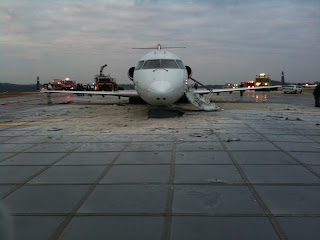 The U.S. National Transportation Safety Board (NTSB) has issued its final report on the PSA Airlines CRJ-200 runway overrun at Charleston, WV, in January of this year. The aircraft (registration N246PS) overran a runway at Yeager Airport (CRW), Charleston, WV, following a rejected takeoff. The NTSB report attributes the incident to the flight crew's "unprofessional behavior."
The incident flight, operating as US Airways Express Flight 2495, was departing Charleston for Charlotte Douglas International Airport, NC. After noticing that the flaps were incorrectly configured for takeoff, the crew rejected takeoff at high speed -- well above V1. The aircraft overran the end of the runway and came to a stop in the engineered materials arresting system (EMAS) in the runway end safety area.
There were no injuries among the three crew members and 31 passengers on board. The aircraft's flaps, landing gear, and landing gear doors "received minor damage," according to the NTSB.
The NTSB's statement of probable cause is as follows:
RELATED: PSA Airlines CRJ-200 runway overrun at Charleston, WV - AircrewBuzz.com, Jan 19, 2010
[Photo Source]
 The U.S. National Transportation Safety Board (NTSB) has issued its final report on the PSA Airlines CRJ-200 runway overrun at Charleston, WV, in January of this year. The aircraft (registration N246PS) overran a runway at Yeager Airport (CRW), Charleston, WV, following a rejected takeoff. The NTSB report attributes the incident to the flight crew's "unprofessional behavior."
The incident flight, operating as US Airways Express Flight 2495, was departing Charleston for Charlotte Douglas International Airport, NC. After noticing that the flaps were incorrectly configured for takeoff, the crew rejected takeoff at high speed -- well above V1. The aircraft overran the end of the runway and came to a stop in the engineered materials arresting system (EMAS) in the runway end safety area.
There were no injuries among the three crew members and 31 passengers on board. The aircraft's flaps, landing gear, and landing gear doors "received minor damage," according to the NTSB.
The NTSB's statement of probable cause is as follows:
(1) The flight crewmembers’ unprofessional behavior, including their nonadherence to sterile cockpit procedures by engaging in nonpertinent conversation, which distracted them from their primary flight-related duties and led to their failure to correctly set and verify the flaps;Here are the links to the NTSB's final report:
(2) the captain’s decision to reconfigure the flaps during the takeoff roll instead of rejecting the takeoff when he first identified the misconfiguration, which resulted in the rejected takeoff beginning when the airplane was about 13 knots above the takeoff decision speed and the subsequent runway overrun; and
(3) the flight crewmembers’ lack of checklist discipline, which contributed to their failure to detect the incorrect flap setting before initiating the takeoff roll.
Contributing to the survivability of this incident was the presence of an engineered materials arresting system beyond the runway end.
RELATED: PSA Airlines CRJ-200 runway overrun at Charleston, WV - AircrewBuzz.com, Jan 19, 2010
[Photo Source]
Thursday, October 28, 2010
American Airlines Boeing 757 with hole in fuselage lands safely at Miami
by B. N. Sullivan
Earlier this week, an American Airlines Boeing 757-200 aircraft made an emergency landing at Miami International Airport after experiencing a rapid decompression. The incident occurred late on the evening of October 26, 2010 not long after the aircraft had departed Miami en route to Boston. After the aircraft landed safely, it was discovered to have a hole in the fuselage. No one was injured.
The Aviation Herald published this brief description of the incident:
If you are thinking this incident sounds vaguely familiar, you are not alone. When I heard about it, the first thing that came to mind was a similar incident in 2009 involving a Southwest Airlines Boeing 737-300. In that case, the National Transportation Safety Board (NTSB) determined the probably cause to be: "Fuselage skin failure due to pre-existing fatigue at a chemically milled step."
To refresh your memory, you can click here to read about the Southwest B737 incident.
Earlier this week, an American Airlines Boeing 757-200 aircraft made an emergency landing at Miami International Airport after experiencing a rapid decompression. The incident occurred late on the evening of October 26, 2010 not long after the aircraft had departed Miami en route to Boston. After the aircraft landed safely, it was discovered to have a hole in the fuselage. No one was injured.The Aviation Herald published this brief description of the incident:
An American Airlines Boeing 757-200, registration N626AA performing flight AA-1640 from Miami,FL to Boston,MA (USA) with 154 passengers and 6 crew, had been cleared to climb to FL310 when the airplane suffered a rapid decompression. The crew donned their oxygen masks and initiated an emergency descent, the passenger oxygen masks were deployed. After reaching 10,000 feet the crew requested even lower and descended further to 8000 feet and returned to Miami for a safe landing on Miami's runway 08R about 40 minutes after departure.Visit the Aviation Herald to view photos of the damaged aircraft. Pretty sobering stuff!
A post flight inspection revealed a hole of about 1 foot by 2 feet (33 by 66cm) just above and aft of the L1 door and just above the "A" of the American Airlines Logo.
If you are thinking this incident sounds vaguely familiar, you are not alone. When I heard about it, the first thing that came to mind was a similar incident in 2009 involving a Southwest Airlines Boeing 737-300. In that case, the National Transportation Safety Board (NTSB) determined the probably cause to be: "Fuselage skin failure due to pre-existing fatigue at a chemically milled step."
To refresh your memory, you can click here to read about the Southwest B737 incident.
Thursday, October 21, 2010
Plane crash attributed to escaped crocodile on board: True or not?
by B. N. Sullivan
 According to a story that has popped up on several news Web sites, a crocodile may have been instrumental in causing the fatal crash of a Let L-410 turboprop aircraft earlier this year. The gist of the story is as follows:
What is certain is that the aircraft, operated by Filair, went down near Bandundu, Democratic Republic of Congo (DRC) on August 25, 2010, killing 19 people, including the crew. There was one survivor. Some time later he, too, was reported to have died of his injuries, but not before he was able to give a statement about the accident to investigating authorities.
Within days of the accident, the Aviation Herald reported this account:
Here are links to two of the news stories featuring the crocodile version on Telegraph.co.uk and News.com.au.
So, what do you think? Does the crocodile story sound plausible? Or do you think this is a rumor turned legend-in-the-making?
[Image Source]
RELATED: Fatal crash of Filair Let L-410 at Bandundu, DR Congo

- a passenger smuggled a crocodile on board in hand baggage
- the crocodile escaped from the bag as the aircraft was descending
- frightened at the sight of the reptile, the flight attendant and passengers rushed forward
- this altered the aircraft's center of gravity
- the crew lost control of the aircraft and it crashed
What is certain is that the aircraft, operated by Filair, went down near Bandundu, Democratic Republic of Congo (DRC) on August 25, 2010, killing 19 people, including the crew. There was one survivor. Some time later he, too, was reported to have died of his injuries, but not before he was able to give a statement about the accident to investigating authorities.
Within days of the accident, the Aviation Herald reported this account:
On Aug 27th Filair said the only survivor of the crash was able to provide testimony to investigators. According to this statement the crew had been told to land on a "reserve strip" alongside the main runway. The passengers noticed that the airplane was not heading for the runway 11/29 (1380 meters/4530 feet long) and began shouting, then rushed to the cockpit unbalancing the aircraft to a point, where control was lost. Fuel exhaustion was not the problem, 150 liters of fuel were recovered from the wreckage. The black boxes were recovered from the wreckage by the Civil Aviation Authority and are being analysed.No mention of crocodiles at that time.
Here are links to two of the news stories featuring the crocodile version on Telegraph.co.uk and News.com.au.
So, what do you think? Does the crocodile story sound plausible? Or do you think this is a rumor turned legend-in-the-making?
[Image Source]
RELATED: Fatal crash of Filair Let L-410 at Bandundu, DR Congo
Tuesday, October 12, 2010
Fatal L-100 Hercules cargo plane crash in Afghanistan
by B. N. Sullivan
 An L-100 Hercules cargo aircraft has crashed in the mountains of Afghanistan near Kabul, killing all on board. The aircraft, owned by Transafrik International and operating as a charter for National Air Cargo as Flight MUA-662, was en route from Bagram Air Base (BPM) to Kabul (KBL) at the time of the accident. The accident occurred on October 12, 2010 at about 19:30 local time.
News reports about the accident vary as to whether there were seven, eight or nine people on board. In any case, all on board are reported to have perished in the accident.
Few details are available, but Afghan news website Pajhwok.com quoted an eyewitness who said the plane "burst into flames after crashing into mountains in the Mahipar pass." The Mahipar pass is situated along the highway between Kabul and Jalalabad.
An AFP article about the accident quoted a police official from the area near the accident site who said the fire was still burning two hours after the crash.
The Lockheed L-100 is the civilian equivalent of the military C-130.
News reports about the accident vary as to whether there were seven, eight or nine people on board. In any case, all on board are reported to have perished in the accident.
Few details are available, but Afghan news website Pajhwok.com quoted an eyewitness who said the plane "burst into flames after crashing into mountains in the Mahipar pass." The Mahipar pass is situated along the highway between Kabul and Jalalabad.
An AFP article about the accident quoted a police official from the area near the accident site who said the fire was still burning two hours after the crash.
The Lockheed L-100 is the civilian equivalent of the military C-130.
Sunday, September 26, 2010
ASA CRJ-900 landing drama at JFK ends well for all on board
by B. N. Sullivan
High drama at New York's John F. Kennedy International Airport on Saturday evening, September 25, 2010: A CRJ-900 aircraft (registration N133EV) operated by Atlantic Southeast Airlines (ASA) landed with its right main landing gear retracted. ASA Flight 4951 -- also listed as Delta Connection Flight 4951 -- had been en route from Atlanta's Hartsfield-Jackson International Airport (ATL) to Westchester County (HPN), but diverted to JFK after the crew were unable to lower the right main gear while on approach to HPN. The aircraft landed on JFK's runway 31R and came to a stop with its right wing scraping the surface. The aircraft was evacuated on the runway. To the credit of the pilots and flight attendants, no one among the four crew and 60 passengers on board was injured.
The video below was posted on New York Daily News YourTube channel. The video reportedly was shot during landing by a passenger on board the flight.
If the video does not play or display properly above, click here to view it on YouTube.
High drama at New York's John F. Kennedy International Airport on Saturday evening, September 25, 2010: A CRJ-900 aircraft (registration N133EV) operated by Atlantic Southeast Airlines (ASA) landed with its right main landing gear retracted. ASA Flight 4951 -- also listed as Delta Connection Flight 4951 -- had been en route from Atlanta's Hartsfield-Jackson International Airport (ATL) to Westchester County (HPN), but diverted to JFK after the crew were unable to lower the right main gear while on approach to HPN. The aircraft landed on JFK's runway 31R and came to a stop with its right wing scraping the surface. The aircraft was evacuated on the runway. To the credit of the pilots and flight attendants, no one among the four crew and 60 passengers on board was injured.
The video below was posted on New York Daily News YourTube channel. The video reportedly was shot during landing by a passenger on board the flight.
If the video does not play or display properly above, click here to view it on YouTube.
Tuesday, September 14, 2010
Update on the UPS Boeing 747 freighter crash in Dubai
by B. N. Sullivan
 The General Civil Aviation Authority (GCAA) of the United Arab Emirates has provided some preliminary details about its investigation of the crash of a UPS Boeing 747-400 freighter in Dubai earlier this month. The accident occurred on September 3, 2010. Both pilots perished in the accident.
In a news release dated September 5, 2010, the GCAA gave this account of the accident:
An article published online by the Khaleej Times reported on preliminary data gathered by the GCAA.
RELATED: Click here to view all articles about this accident on Aircrew Buzz.

In a news release dated September 5, 2010, the GCAA gave this account of the accident:
The UPS6 B744 had departed from Dubai International Airport at 14:53 UTC (6:53pm local time) headed to Koln-Bonn (Cologne) - Germany. At 15:15 UTC (7:15pm local time) information was received from Bahrain that the aircraft was returning to Dubai Airport with a smoke in the cockpit, unable to maintain altitude and requested the airport for landing.Then, in a news release dated September 13, 2010, the GCAA announced that the Digital Flight Data Recorder (DFDR) also had been recovered from the aircraft wreckage, and was in "reasonable condition." The GCAA said that both devices were being sent to the United States for analysis. One GCAA investigator will travel to the U.S. "to work on data recovery with the American investigation team."
The UAE ATC Centre issued a clearance when aircraft was approximately 40 kilometer from touchdown. The aircraft was high on the approach and was at 8500ft at 24 kilometer from touchdown. It passed the overhead the airfield very high and made a right turn. Position reports were passed the tower as well as advising that all runways were available for the aircraft to land on. The aircraft tracked south west and rapidly lost altitude. At approximately 15:42 UTC (7:42pm local time), radar contact was lost. The B744 crashed in in an unpopulated area between the Emirates Road and Al Ain Highway after 50 minutes from departure and after returning back from Bahrain FIR (Flight Information Region).
The GCAA responded by launching an immediate investigation team who are currently on site collecting evidence, analyzing the initial onsite evidence, coordinating with all of the emergency services to secure the accident site, liaising with the aircraft manufacturer technical specialists and international accident investigation bodies who have invited to assist the GCAA onsite in the UAE under the provisions of ICAO Annex 13.
The investigation team recovered the Cockpit Voice Recorder (CVR) approximately 6 hours after the accident; the onsite GCAA investigation team is continuing the recovery effort to locate the Digital Flight Data Recorder (DFDR), while investigating the aircraft structure, systems, engines and flight controls as part of the forensic evidence collecting and data capturing activities associated with major air accident investigation.
An article published online by the Khaleej Times reported on preliminary data gathered by the GCAA.
The initial analysis of the downloaded data indicated that there was a fire warning followed by smoke in the cockpit as reported by the crew about 28 minutes from takeoff. The crew were asked by Bahrain Air Traffic Control to land at Doha, but they decided to return to Dubai. Then they experienced cockpit visibility and commutation problems. Later on the crew declared Mayday (a call used to declare that aircraft is in distress). The Captain was in control up to the end of the recording.The investigation is continuing.
RELATED: Click here to view all articles about this accident on Aircrew Buzz.
Monday, September 13, 2010
Conviasa ATR-42 accident at Puerto Ordaz, Venezuela
by B. N. Sullivan
 An ATR-42-300 turboprop aircraft operated by Venezuelan carrier Conviasa crashed this morning at Puerto Ordaz, Ciudad Guyana in eastern Venezuela. The aircraft (registration YV1010) impacted terrain on the grounds of an industrial facility called Siderurgica del Orinoco (SIDOR). The flight was reported to have 47 on board. News reports from Venezuela say that at least 13 passengers were fatally injured. All four crew members are said to have survived. The aircraft was destroyed in the crash.
There is still some confusion about the flight's origin and destination. Some news reports say that the aircraft had just departed Puerto Ordaz (SPVR) en route to Porlamar (SVMG), while other reports say that the aircraft was on approach to Puerto Ordaz from Isla Margarita at the time of the accident. When the correct information emerges, I will post an update here.
Venezuelan television network Globovisión has posted a number of photos of the accident scene on Flickr.
UPDATE: The Aviation Safety Network reports:
UPDATE Sep 14, 2010: Earlier today, Transportation Minister Francisco Garces told news reporters that some of those who initially survived the Conviasa accident had succumbed to their injuries, raising the death toll to 17.
Condolences to all those who have lost a family member or friend in this accident.

There is still some confusion about the flight's origin and destination. Some news reports say that the aircraft had just departed Puerto Ordaz (SPVR) en route to Porlamar (SVMG), while other reports say that the aircraft was on approach to Puerto Ordaz from Isla Margarita at the time of the accident. When the correct information emerges, I will post an update here.
Venezuelan television network Globovisión has posted a number of photos of the accident scene on Flickr.
UPDATE: The Aviation Safety Network reports:
Flight Conviasa 2350 had departed Porlamar-del Caribe Santiago Mariño International Airport (PMV) on a domestic service to Puerto Ordaz Airport (PZO). It came down in an industrial area about 8 km from runway 07.UPDATE 2: Here is a link to a news release about the accident issued by Venezuela's Instituto Nacional de Aeronáutica Civil (INAC).
Conflicting news reports indicate that the airplane also have been on a flight from Puerto Ordaz to Porlamar. Yet the flight number mentioned by several other news sources is a flight from PMV to PZO.
UPDATE Sep 14, 2010: Earlier today, Transportation Minister Francisco Garces told news reporters that some of those who initially survived the Conviasa accident had succumbed to their injuries, raising the death toll to 17.
Condolences to all those who have lost a family member or friend in this accident.
Sunday, September 12, 2010
JetBlue Airbus A320 landed with parking brake engaged, says NTSB
by B. N. Sullivan
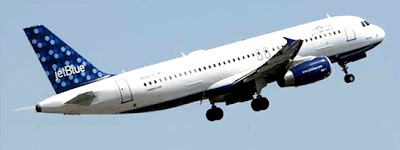 The U.S. National Transportation Safety Board (NTSB) has issued a preliminary report on an incident last month involving an Airbus A320-232 aircraft operated by JetBlue Airways. On August 26, 2010, the aircraft (registration N590JB) flew from Daugherty Field, Long Beach, CA (LGB) to Sacramento International Airport (SMF), operating as Flight JBU 262. Shortly after landing at Sacramento, a fire erupted in the area of the main landing gear, prompting the crew to carry out an emergency evacuation of the aircraft on the runway. The NTSB found that the aircraft's parking brake was engaged during the landing.
From the NTSB preliminary report:
It is still unclear how the parking brake became engaged during flight. The investigation is continuing.
[Photo Source]
 The U.S. National Transportation Safety Board (NTSB) has issued a preliminary report on an incident last month involving an Airbus A320-232 aircraft operated by JetBlue Airways. On August 26, 2010, the aircraft (registration N590JB) flew from Daugherty Field, Long Beach, CA (LGB) to Sacramento International Airport (SMF), operating as Flight JBU 262. Shortly after landing at Sacramento, a fire erupted in the area of the main landing gear, prompting the crew to carry out an emergency evacuation of the aircraft on the runway. The NTSB found that the aircraft's parking brake was engaged during the landing.
From the NTSB preliminary report:
According to the flight crew, the flight and approach to runway 16R were normal. The first officer was the flying pilot.Seven of the 86 passengers on board sustained minor injuries during the evacuation process. The two pilots and three flight attendants were not injured.
On touchdown, the airplane began a rapid deceleration, and the first officer remarked to the captain that it felt like a main landing gear tire blew out. About this time, air traffic control tower personnel reported observing sparks and smoke in the area of the main landing gear. The captain took control of the airplane. He maintained directional control, and the airplane came to a stop about 2,000 feet from the touchdown point.
The captain directed the first officer to initiate the ground evacuation Quick Reference Checklist up to the evacuation decision point. At that time, air traffic control tower personnel confirmed smoke and fire was still visible around the main landing gear. Based on this information the captain elected to evacuate the airplane.
Crash fire rescue personnel and equipment responded to the airplane, which had stopped on the runway. According to the flight crew and flight attendants, a swift and orderly evacuation was performed via emergency evacuation slides at the L1, R1, and L2 doors.
The airplane was subsequently examined by the operator and Federal Aviation Administration (FAA) personnel. Airplane damage was limited to four deflated main landing gear tires and ground down wheel rims. The main landing gear tires showed evidence of being locked on touchdown. Ground damage was limited to minor grazing to the runway's surface.
According to airplane recorded flight data, the parking brake had become engaged during the landing approach approximately 5,100 feet mean sea level, and it remained engaged throughout the landing. During interviews with the flight crew, neither pilot recalled any abnormal indications or warnings associated with the braking system prior to landing. [NTSB ID: WPR10IA430]
It is still unclear how the parking brake became engaged during flight. The investigation is continuing.
[Photo Source]
Subscribe to:
Posts (Atom)